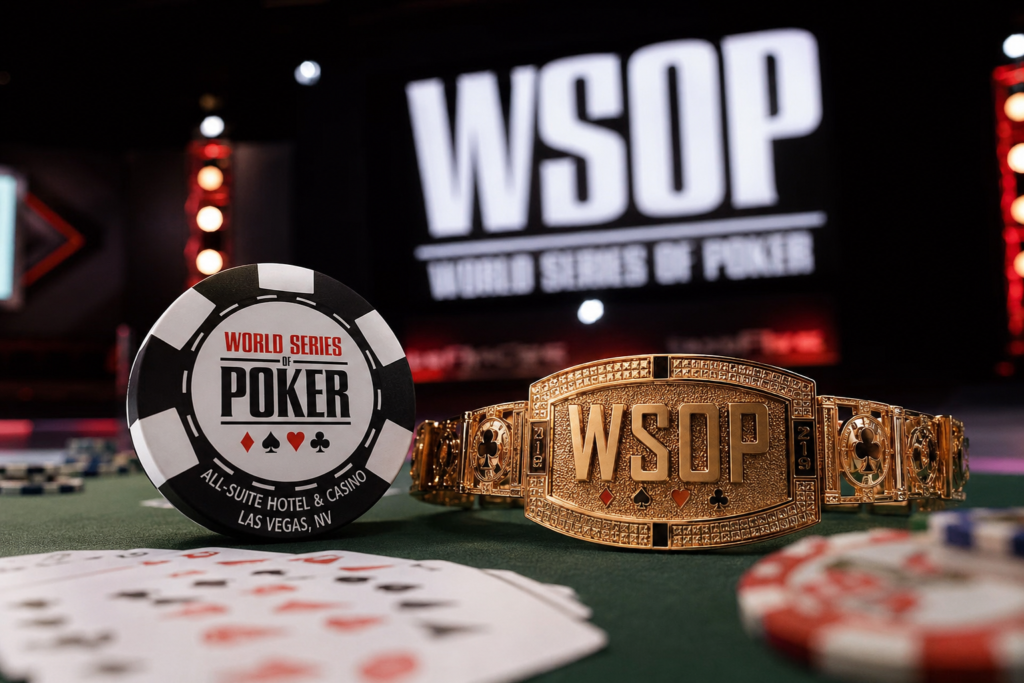
The World Series of Poker (WSOP) is the longest-running and best-known series of poker tournaments in the world. It is not a single tournament. Each summer in Las Vegas it runs around 100 separate events across many poker variants, with buy-ins from a few hundred dollars to $250,000. Every event winner receives a gold bracelet, and the $10,000 No-Limit Hold’em Main Event crowns poker’s world champion. The brand now also includes WSOP Europe, WSOP Paradise, the year-round WSOP Circuit and online bracelet series.
This guide covers how the WSOP began, how its tournaments work, what they cost, how players qualify, and how bracelet events, Circuit rings and the Main Event differ. Historical facts, current records and 2026 figures are labelled throughout.
What Does WSOP Stand For?
WSOP stands for World Series of Poker. The name borrows from baseball’s World Series and describes a championship festival rather than a single game. In practice, “WSOP” can mean the annual Las Vegas series, the wider family of events that carry the brand, or the organisation behind them. That organisation changed hands in October 2024, when Caesars Entertainment sold the brand to NSUS Group, the parent company of GGPoker, for $500 million. Caesars kept the right to host the Las Vegas series for 20 years and a licence to run WSOP Online in four US states.
What Is the World Series of Poker?
In practical terms, the World Series of Poker is a calendar of tournaments. The 2026 Las Vegas series ran from May 26 to July 15 at Horseshoe Las Vegas and Paris Las Vegas and awarded 100 bracelets. According to the WSOP, those events drew a record 251,899 entries and paid out more than $469 million.
A single poker tournament has one buy-in, one field and one winner. The WSOP is dozens of those, each with its own buy-in, game, structure and prize pool. A player might enter a $500 Hold’em event on Monday and a $1,500 Seven Card Stud event on Wednesday; each is a separate competition. The Main Event is the most famous piece, but it is one event among many.
History of the WSOP
The First WSOP in 1970
Casino owner Benny Binion created the WSOP at Binion’s Horseshoe in downtown Las Vegas in 1970, inspired by the invitation-only poker gatherings of the era. He invited seven players, including Johnny Moss, Doyle Brunson and “Amarillo Slim” Preston, to play high-stakes cash games and then vote on who was best. By the WSOP’s own account everyone voted for himself, so the group was asked to name the second-best player instead. Johnny Moss won that vote, received a silver cup and became the first champion.
1970 counts as the first WSOP because it was the first gathering held under that name, even though no tournament in the modern sense was played. In 1972 the Main Event adopted the $10,000 buy-in and the freezeout rule (one entry, no rebuys) that still define it; Binion paid half the buy-in for that year’s eight entrants.
How the WSOP Grew
Gold bracelets were first awarded in 1976, replacing earlier trophies, and quickly became the series’ signature prize. Side events in other variants were added through the 1970s and 1980s, turning one championship into a true series, and Johnny Chan won back-to-back Main Events in 1987 and 1988 before 24-year-old Phil Hellmuth denied him a third in 1989. Fields stayed small: 22 players when Doyle Brunson won his first title in 1976, and the Main Event only passed 200 entrants in 1991, the first year it paid a $1 million first prize. By 2002 it had 631 players.
The Poker Boom
In 2003 Chris Moneymaker, an accountant from Tennessee, won his $10,000 seat through an $86 online satellite, beat professional Sammy Farha heads-up and collected $2.5 million from a field of 839. ESPN’s expanded coverage, with hole-card cameras showing each player’s hidden cards, made the tournament gripping television, and Moneymaker’s win convinced amateurs that an ordinary player could qualify cheaply and win.
The “Moneymaker effect” tripled the field to 2,576 in 2004, and in 2006 a record 8,773 players entered, with Jamie Gold winning $12 million. Harrah’s Entertainment (later Caesars) bought the WSOP from the Binion family in 2004 and moved it to the Rio in 2005, where it stayed until 2021. 2003 is the turning point because recreational qualifiers became the majority of every big field.
The Modern WSOP
WSOP Europe launched in 2007, the first online bracelet was awarded in 2015, and the entire 2020 series ran online during the pandemic. In 2022 the WSOP moved to the Las Vegas Strip at Horseshoe and Paris Las Vegas. The 2023 Main Event set a record first prize of $12.1 million (Daniel Weinman) and the 2024 Main Event set the field record of 10,112 entries. Ownership passed to NSUS Group in October 2024, and in 2026 the Main Event returned to ESPN with a delayed, live-televised final table, a format last used in the “November Nine” years (2008–2016).
How Does the WSOP Work?
The WSOP is an ecosystem with several layers. Bracelet events are the core: open tournaments in Las Vegas, at WSOP Europe and WSOP Paradise, and online, where the winner receives a gold bracelet. The Main Event is one of these, with the world championship attached. The WSOP Circuit runs year-round regional stops where winners earn gold rings, and satellites are small tournaments that award seats in bigger events instead of cash.
Within the bracelet schedule, events differ by buy-in, game and format. No-Limit Hold’em dominates, Pot-Limit Omaha is the second pillar, and mixed-game events keep older variants alive; “deepstack” events give players more chips relative to the blinds, and “high-roller” events start at $25,000. There are many tournaments rather than one because poker is not one game, and because a $300 event and a $250,000 event attract completely different fields.
Table 1: WSOP Event Type Comparison (2026 figures)
| Event Type | Typical Format | Main Purpose | Prize / Recognition | Who Can Enter |
| Bracelet event (Las Vegas) | Multi-day tournament in NLH, PLO, stud, draw or mixed games; 2026 buy-ins from $300 to $250,000 | Crown a champion in a specific game at a specific stake | Gold bracelet plus a share of the prize pool | Anyone 21 or older who pays the buy-in or wins a seat |
| Main Event | $10,000 NLH freezeout; four starting flights; about two weeks of play | Decide poker’s world champion | Main Event bracelet and first prize ($10,000,000 in 2026) | Anyone 21 or older with the buy-in or a satellite seat |
| WSOP Circuit | Regional stops with about 18 ring events; $1,700 Main Event at most US stops | Year-round competition closer to home | Gold ring and prize money; 2026 ring winners receive a $5,000 WSOP Paradise package | Anyone who meets the host venue’s age and ID rules |
| WSOP Europe / WSOP Paradise | International bracelet festivals (15 events in Prague in 2026; 20 events at Baha Mar in December 2026) | Bring bracelet competition to Europe and the Caribbean | Gold bracelet and prize money | Open entry; WSOP Europe admits players 18 and over under local rules |
| WSOP Online | Online bracelet series (30 US events in 2026; 33 international events on GGPoker) | Bracelet competition from home | Gold bracelet and prize money | Players legally located in a licensed jurisdiction (21+ in NV, NJ, MI and PA) |
| Satellite | Single-table or multi-table qualifier with a low buy-in | Award seats in bigger events | Tournament entry ticket rather than cash | Same eligibility as the target event |
What Is the WSOP Main Event?
The Main Event’s official name is the $10,000 No-Limit Hold’em World Championship. It has carried the same buy-in since 1972 and is a freezeout, so every player gets one entry. The winner receives the largest bracelet of the series and is recognised as poker’s world champion.
Structure (2026). Every player starts with 60,000 chips. Blinds begin at 100/200 with a 200 big-blind ante, about 300 big blinds, and each level lasts two hours, a slow structure that rewards patience and limits short-term luck.
Field and prize pool (2026). The 2026 edition drew 9,208 entries, the fourth-largest field ever, for an $85,634,400 prize pool. Of each $10,000 buy-in, $9,300 went to the prize pool and $700 covered fees. Play ran in stages:
- Days 1A–1D (July 2–5): four starting flights. A player picks one and, if they survive, bags their chips.
- Day 2ABC and Day 2D: flights combine in two groups, and late registration closes.
- Day 3 onward: the full field plays together. The money bubble, the point at which everyone still seated is guaranteed a payout, burst with 1,383 players left, about 15% of the field; the minimum cash was $15,000. Near the bubble, play goes hand-for-hand, with every table finishing a hand before the next is dealt.
- Days 4–8: the field shrinks from hundreds to the final nine, set on July 13.
- Final table (August 3–5): after a three-week break, the final nine returned for a live ESPN broadcast, playing down to heads-up (one-on-one) to decide the champion.
Lucas Jumalon, a 22-year-old from Spokane, Washington, won $10,000,000 and the bracelet after beating Finland’s Lauri Saaskilahti heads-up. Saaskilahti earned $6,000,000, Greg Mueller $3,750,000, Michael Gagliano $2,750,000 and Han Feng $2,250,000, and sixth to ninth place each received at least $1,000,000.
What Is a WSOP Gold Bracelet?
A WSOP gold bracelet is the trophy awarded to the winner of each bracelet event. It has been the series’ symbol of victory since 1976 and is made by Jostens, which also produces the Circuit rings. The Main Event bracelet is the largest, and the WSOP states the 2025 version was valued at $500,000.
Players value bracelets because they are scarce and permanent. Prize money is spent or lost, but a player’s bracelet count is the standard measure of WSOP success, much as major titles are in golf or tennis. Only designated bracelet events award one; daily deepstacks and satellites do not, and Circuit winners receive a ring instead. Multiple bracelets carry extra weight because each means beating a large field, often in a different game; Phil Hellmuth’s 17, won between 1989 and 2023, remain the record as of August 2026. Whether a bracelet is “worth more than money” is opinion, not fact, but winners routinely describe the bracelet, not the cheque, as the goal.
Who Can Play in the WSOP?
The WSOP is open entry. There is no ranking requirement, no invitation and no need for a sponsor; professionals, recreational players and first-timers enter the same events.
Eligibility follows the law of the host location. Under the official 2026 rules for Las Vegas, entrants must be 21 or older with proof of age and must show valid, unexpired government photo ID at registration (most non-US citizens use a passport). Every player needs free Caesars Rewards and WSOP LIVE accounts, and first-time online registrations are verified in person. WSOP Europe, held in the Czech Republic, admits players aged 18 and over under local rules.
International players are welcome; recent champions have come from Norway, Germany and Argentina. Online is more restricted: US WSOP Online bracelet events require players to be 21 or older and physically located in Nevada, New Jersey, Michigan or Pennsylvania, while GGPoker’s international series depends on its licensing and country rules.
How Much Does It Cost to Play in the WSOP?
The cost depends entirely on the event. At the 2026 Las Vegas series, bracelet buy-ins ranged from $300 (the Gladiators of Poker, with 11,185 entries) to $250,000 (the Super High Roller, with 56). Most events sit between $500 and $5,000, $1,500 is the most common price, and the Main Event is $10,000. Daily deepstacks and satellites cost less.
Every buy-in includes an administrative fee that does not reach the prize pool, and the percentage falls as the buy-in rises. In 2026 the $500 Freezeout returned about 83% of entry money to players, $1,500 events about 88%, $5,000 events 92%, the $25,000 high rollers 94% and the Main Event 93%. Credit-card payments add 2%.
Budget for flights, one to two weeks of Las Vegas hotels in high summer, meals and transport, and remember that prize money is subject to tax reporting, with possible withholding for non-US residents. Nobody needs $10,000 to play the WSOP: a $300 bracelet event, a $1,700 Circuit Main Event or an online satellite costing a few dollars are all ways in.
How Do WSOP Prize Pools and Payouts Work?
A prize pool is entries multiplied by the buy-in, minus the fee, so it varies with the field. In 2026 the $1,000 Mystery Millions drew 22,811 entries, the largest field of the series, while the $250,000 Super High Roller drew 56 players yet paid $13,720,000.
Roughly the top 15% of the field is paid in most WSOP events. The smallest payout, the “min-cash”, is typically about 1.5 times the buy-in, and the ladder climbs steeply: the 2026 Main Event paid 1,383 places from $85.6 million, with a $15,000 minimum, six-figure prizes from around 80th place, $1,000,000 for ninth and $10,000,000 for first. The jump from second to first alone was $4 million, which is why professionals talk about “pay jumps”. In guaranteed events the organiser promises a minimum total, such as the $50 million guarantee on the 2026 WSOP Paradise Super Main Event, and tops up the pool if entries fall short.
How Do You Qualify for the WSOP?
No qualification is required; anyone eligible can pay the buy-in for any open event, including the Main Event. “Qualifying” usually means winning a seat for less than full price. In 2026 the main routes were:
- Direct buy-in at registration or through the WSOP LIVE app.
- Live satellites at the Las Vegas venues before each major event, paying out in entries rather than cash.
- Online satellites. GGPoker’s WSOP Express satellites are the exclusive international route and start at very low stakes; in the United States, WSOP Online ran $215 “25-Seat Scramble” satellites for the Main Event.
- Packages and promotions. Every 2026 Circuit ring winner received a $5,000 WSOP Paradise package, and partner sites ran seat giveaways; these offers change yearly and by country.
Read satellite terms carefully: some packages include travel and hotel, some pay a ticket only, and tickets are often non-transferable.
Table 4: How to Enter a WSOP Event (2026 routes)
| Route | How It Works | Typical Cost | Suitable For |
| Direct buy-in | Register and pay the posted buy-in in person or through the WSOP LIVE app | $300 to $250,000 for 2026 Las Vegas bracelet events; $10,000 for the Main Event | Players whose bankroll comfortably covers the event |
| Live satellite | Single- or multi-table qualifier at the venue; prizes are seats, not cash | A fraction of the target buy-in; amounts vary by satellite (check the official satellite schedule) | Players already in Las Vegas who want a cheaper shot |
| Online satellite | Step tournaments on GGPoker (international) or WSOP Online (NV, NJ, MI, PA) | From well under $1 on GGPoker WSOP Express; $215 Main Event seat scrambles on WSOP Online in 2026 | Recreational players and grinders building up from small stakes |
| Circuit ring package | Win any 2026 WSOP Circuit ring event | Circuit buy-ins from a few hundred dollars; $1,700 Main Events at most US stops | Players who want regional competition plus a funded trip to WSOP Paradise |
| Promotions | Leaderboards, giveaways and partner packages | Often free or low-cost; rules vary by year and jurisdiction | Anyone who checks the terms and eligibility first |
What Happens During a WSOP Tournament?
- Select an event. Read the structure sheet for buy-in, game, starting stack, level length, re-entry rules and number of days.
- Create Caesars Rewards and WSOP LIVE accounts, then register online or at the cage with photo ID.
- Pay the buy-in. Cash, casino chips, card (plus 2%), cashier’s cheque, transfer, tournament account or a satellite ticket.
- Receive your seat and chips. Table and seat are assigned at random, and your starting stack is waiting at the table.
- Play the opening flight. Blinds rise on a schedule and players who lose all their chips are out unless the event allows re-entry.
- Survive to the next day. Survivors “bag and tag” their chips in a sealed bag and return the next day.
- Reach the money. Play goes hand-for-hand until enough players bust; once you are “in the money”, your finishing position sets your payout.
- Continue through the field. Tables break and combine as players leave, and the payout rises at each pay jump.
- Reach the final table. Seats are redrawn, and big events move to a broadcast stage.
- Play for the title and bracelet. Heads-up play decides the winner, who receives the bracelet and the top prize.
Expect 10- to 12-hour days, an English-only rule while cards are in play, and strict limits on phones and devices.
Types of WSOP Events
The 2026 schedule used these formats, sometimes combined in one event:
- Freezeout: one entry; lose your chips and you are out. The Main Event is a freezeout.
- Re-entry: busted players may buy in again while registration is open.
- Bounty: part of each buy-in is paid to whoever eliminates that player.
- Mystery bounty: bounty values are hidden until claimed, some worth up to $1,000,000 in the Mystery Millions.
- Turbo and Super Turbo: short levels for a one-day finish.
- Deepstack: more starting chips relative to the blinds, such as the $1,500 Monster Stack.
- Shootout: win your whole table to advance.
- Six-max and eight-handed: fewer players per table and more hands.
- Heads-up: a bracket of one-on-one matches, such as the $25,000 Heads-Up Championship.
- Mixed games: the game rotates each orbit or by dealer’s choice.
- High roller: $25,000 and up, to $250,000 in 2026.
- Championship events: the $10,000 version of a variant, such as the $10,000 Razz Championship, and the $50,000 Poker Players Championship mixed-game marathon.
- Restricted-entry events: Seniors (50 and over), Super Seniors, Ladies, Industry Employees and Tag Team.
Poker Games Played at the WSOP
No-Limit Texas Hold’em is the headline game: two hidden cards each, five shared community cards, and any player may bet all their chips at any time. Pot-Limit Omaha, with four hole cards of which exactly two must be used, has become the second pillar, with events from $1,500 to $100,000 in 2026. The rest of the schedule preserves older forms: Seven Card Stud, Razz, Omaha Hi-Lo, Limit Hold’em, 2-7 Lowball draw games, Badugi and rotations such as H.O.R.S.E., 8-Game and Dealer’s Choice. The lineup changes every year, so a variant offered one summer may be gone the next.
Table 2: Major Poker Variants at the WSOP (examples from the 2026 schedule)
| Variant | Basic Concept | Common Skill Focus | Example WSOP Event Type |
| No-Limit Texas Hold’em | Two hole cards, five community cards; bet any amount up to your stack | Hand reading, bet sizing, bluffing, stack management | $10,000 Main Event; the majority of bracelet events |
| Pot-Limit Omaha | Four hole cards, use exactly two; bets capped at the size of the pot | Equity calculation, drawing hands, position | $1,500 PLO; $10,000 PLO Championship; $100,000 PLO High Roller |
| Omaha Hi-Lo (8 or Better) | Pot split between the best high hand and the best qualifying low hand | Scooping both halves, avoiding split pots | $1,500 Omaha Hi-Lo; $10,000 Omaha Hi-Lo Championship |
| Seven Card Stud | Seven cards dealt to each player, some face up, no community cards; limit betting | Remembering folded cards, reading exposed cards | $1,500 Seven Card Stud; $10,000 Seven Card Stud Championship |
| Razz | Seven Card Stud played for the lowest hand | Patience, reading up-cards, limit discipline | $1,500 Razz; $10,000 Razz Championship |
| H.O.R.S.E. | Rotation of Hold’em, Omaha Hi-Lo, Razz, Seven Card Stud and Stud Hi-Lo | Versatility across five games | $1,500 H.O.R.S.E.; $10,000 Championship; $25,000 High Roller H.O.R.S.E. |
| Mixed games (8-Game, 9-Game, Dealer’s Choice) | Larger rotations that add draw and lowball games | Breadth of knowledge, adjusting quickly between games | $1,500 8-Game; $3,000 Nine Game Mixed; $50,000 Poker Players Championship |
| Other variants | 2-7 Lowball (single and triple draw), Badugi, Limit Hold’em, Big O (five-card Omaha Hi-Lo) | Specialised draw and lowball strategy | $1,500 Badugi; $10,000 No-Limit 2-7 Lowball Draw Championship |
WSOP Circuit
The WSOP Circuit, launched in 2005, is the regional tour. Each stop runs about 18 “ring events” over roughly ten days, with buy-ins from a few hundred dollars and a $1,700 No-Limit Hold’em Main Event at most US stops. Winners receive a gold ring rather than a bracelet. The WSOP stages around 50 stops a year across five continents, and from 2026 the season follows a January-to-December calendar. Fields can be large: the Harrah’s Cherokee Main Event in August 2026 drew 1,681 entries and paid $363,703 to the winner.
Rings matter because they are official WSOP titles available without a Las Vegas trip, and because they open doors: every 2026 ring winner receives a $5,000 package to the Circuit Championship at WSOP Paradise. For aspiring professionals, the Circuit is a proving ground full of experienced opponents.
WSOP Europe and WSOP Paradise
WSOP Europe launched in London in 2007 to bring bracelet events to European players. After stops in Cannes, Paris, Berlin and, from 2017 to 2025, Rozvadov in the Czech Republic, it moved in 2026 to King’s Casino inside the Hilton Prague and shifted to spring (March 31 to April 12) with 15 bracelet events. Halving the Main Event buy-in from €10,350 to €5,300 produced a record 2,617 entries and a €13,085,000 prize pool; Lithuania’s Marius Kudzmanas won €2,000,000. A European bracelet counts the same as one won in Las Vegas.
WSOP Paradise began in 2023 at Atlantis Paradise Island in the Bahamas as a winter festival for the international and online player base. The 2025 $25,000 Super Main Event drew 2,891 entries for a $72,275,000 pool, won by Austria’s Bernhard Binder for $10,000,000. In 2026 the festival moves to Baha Mar (December 2 to 17) with 20 bracelet events, $120 million in guarantees and a $26,000 Super Main Event guaranteeing $50 million, and it decides the WSOP Player of the Year race that spans Europe, Las Vegas and the Bahamas.
WSOP Online
WSOP Online is the bracelet series played over the internet. The first online bracelet went to Anthony Spinella in 2015 in a $1,000 event for Nevada players, and in 2020 the whole series ran online on WSOP.com and GGPoker.
Two series now exist. In the United States, WSOP Online (run by Caesars under licence) held 30 bracelet events from May 30 to July 14, 2026, for players 21 or older located in Nevada, New Jersey, Michigan or Pennsylvania. Internationally, GGPoker hosts WSOP Online from August 16 to September 29, 2026 with 33 bracelets and a $5,000 Main Event guaranteeing $25 million; the 2025 edition paid out more than $354 million across its schedule.
Online play is faster, allows several tables at once and automates late registration and re-entry. Availability depends on local gambling law, so an event open in one state or country may be unavailable in another, and the online series also feed the live events through satellites and packages.
Famous WSOP Players
A few names explain how the WSOP’s history was built.
- Johnny Moss: the first champion (1970), three-time Main Event winner (1970, 1971, 1974) and, at 66, still the oldest champion; his ninth bracelet came in 1988, shortly before his 81st birthday.
- Doyle Brunson: Main Event champion in 1976 and 1977, 10-time bracelet winner and author of Super/System, who played the series for more than 50 years until his death in May 2023.
- Stu Ungar: the only other three-time champion (1980, 1981, 1997); his 1997 win, staked by Billy Baxter after years of addiction, is poker’s most famous comeback.
- Johnny Chan: back-to-back champion in 1987 and 1988 (the 1988 final hand against Erik Seidel appears in Rounders) and the first player to reach 10 bracelets, in 2005.
- Phil Hellmuth: champion at 24 in 1989 and the all-time bracelet leader with 17, the last in 2023; he finished second in a 2026 event while chasing number 18.
- Phil Ivey: 11 bracelets, second all-time and none in No-Limit Hold’em; his 2024 win ended a ten-year drought.
- Erik Seidel: 10 bracelets across four decades and the 1988 runner-up.
- Daniel Negreanu: eight bracelets (the eighth in the 2026 $100,000 PLO High Roller), the only two-time Player of the Year (2004, 2013) and the WSOP’s all-time money leader with more than $36 million.
- Chris Moneymaker: one bracelet, the 2003 Main Event, which changed the game more than most careers.
- Michael Mizrachi: nine bracelets, a record four Poker Players Championship titles and the 2025 Main Event, a double that earned an immediate Hall of Fame vote.
Major WSOP Records
Historical records (long-standing):
- Most Main Event titles: Johnny Moss and Stu Ungar, three each.
- Back-to-back Main Event champions: Moss (1970–71), Brunson (1976–77), Ungar (1980–81) and Chan (1987–88).
- Youngest Main Event champion: Joe Cada, 21, in 2009. Lucas Jumalon (22) became the second-youngest in 2026.
- Oldest Main Event champion: Johnny Moss, 66, in 1974. Oldest bracelet winner: Farhintaj Bonyadi, 83, in the 2018 Super Seniors event.
- Largest Main Event first prize: $12,100,000 to Daniel Weinman in 2023, beating Jamie Gold’s $12,000,000 from 2006.
Current records (verified August 2026):
- Most bracelets: Phil Hellmuth, 17 (1989–2023).
- Largest Main Event field: 10,112 entries in 2024. Largest Main Event prize pool: $94,041,600 in 2024.
- Largest prize pool for any WSOP event other than the Main Event: $72,275,000, 2025 WSOP Paradise Super Main Event.
- Largest single-series turnout: 251,899 entries across 100 events, Las Vegas 2026.
- Highest career WSOP earnings: Daniel Negreanu, $36.26 million.
- Notable final-table feats: Doyle Brunson made seven Main Event final tables (1971–1983); Mizrachi’s 2025 Poker Players Championship and Main Event double is unmatched.
WSOP vs Other Major Poker Series
Table 3: WSOP vs Other Major Poker Series
| Series | Established | Main Championship / Feature | Geographic Reach | Major Distinction |
| World Series of Poker (WSOP) | 1970, Las Vegas | $10,000 NLH Main Event (world championship); about 100 bracelet events each summer | Las Vegas; Europe; Bahamas; roughly 50 Circuit stops on five continents; online | Oldest series; gold bracelets are poker’s standard measure of titles |
| World Poker Tour (WPT) | 2002 | WPT World Championship plus a season of televised Main Events (Main Tour buy-ins roughly $3,500–$25,000) | North America, Europe, Asia and Australia | Built televised poker’s modern look; winners join the WPT Champions Club |
| European Poker Tour (EPT) | 2004 (PokerStars) | EPT Main Events at stops such as Barcelona, Monte Carlo and Prague | Europe, with PokerStars sister tours in other regions | Europe’s most prestigious tour; awards a trophy rather than jewellery |
| Triton Poker Series | 2016 (first festival) | Super high-roller festivals with six- and seven-figure buy-ins | Rotating international venues, including a 2025 partnership at WSOP Paradise | Highest stakes in tournament poker; small, elite fields |
The WSOP stands apart on history and scale: more than $4 billion in prize money since 1970 and a world champion every year. The WPT and EPT built their reputations on television and on polished single Main Events, which some players prefer to the crowded Las Vegas summer, while Triton serves the top of the high-roller market. A WSOP bracelet, a WPT title and an EPT title are all career-defining; the bracelet simply has the longest record and the widest recognition.
Can Beginners Play in the WSOP?
Yes. There is no skill test, and thousands of first-timers enter every summer. The Main Event mixes full-time professionals, online qualifiers and once-a-year recreational players, which is what makes it exciting and also why beginners should be realistic: about 85% of any field leaves with nothing, and the opponents include the best in the world.
A sensible first WSOP is a low buy-in bracelet event, a daily deepstack or a Circuit stop near home. Satellites are a cheaper way to win a seat, and tournament strategy, hand rankings and bankroll management are worth studying first. Treat a first visit as experience, not an income plan.
Is the WSOP Gambling or a Sport?
Poker sits between the two. In any one hand the cards decide a great deal; over thousands of hands, better decisions win more often. The WSOP’s own 2026 rules call poker “primarily and largely a game of skill” while noting that any hand or event also depends on the cards dealt and on opponents’ actions. The same names reach final tables year after year, yet nobody has won back-to-back Main Events since 1988, because variance in a 9,000-player field is enormous.
Legal classifications vary. Some jurisdictions regulate poker as gambling, some distinguish it from pure games of chance, and some restrict online play while permitting live play, which is why WSOP Online is available in only four US states and why the minimum age is 21 in Las Vegas but 18 in Prague. For a player the conclusion is the same either way: skill improves long-term results, but money put into a tournament is money at risk.
Responsible Poker and Bankroll Considerations
Every tournament entry can be lost in full, and most are. Treat buy-ins as entertainment or risk capital, never as an investment or income. Set a budget before booking the trip, keep it separate from living expenses, and stop when it is gone rather than chasing losses in a bigger event. Professionals keep many buy-ins in reserve for any stake they play regularly, because even strong players go long stretches without cashing.
Take breaks, sleep properly, and avoid playing tired or upset. The WSOP offers deposit limits and self-exclusion tools on its online platforms, and support lines such as 1-800-GAMBLER are available in the United States. If poker stops feeling like a game, step away.
Frequently Asked Questions
What does WSOP stand for?
WSOP stands for World Series of Poker, an annual series of poker tournaments founded in Las Vegas in 1970 and owned since 2024 by NSUS Group, the parent company of GGPoker.
What is the WSOP Main Event?
The Main Event is the $10,000 No-Limit Hold’em World Championship, the series’ flagship freezeout. In 2026 it drew 9,208 entries, built an $85.6 million prize pool and paid $10,000,000 to champion Lucas Jumalon.
How much does it cost to enter the WSOP?
Buy-ins at the 2026 Las Vegas series ranged from $300 to $250,000, with the Main Event at $10,000. Daily deepstacks and satellites cost less, and satellite wins can cut the cost of a seat substantially.
Can anyone play in the WSOP?
Anyone who meets the host venue’s age and identification rules can enter open events. In Las Vegas that means 21 or older with valid photo ID; no invitation, ranking or sponsor is needed.
How do you qualify for the WSOP Main Event?
You can buy in directly, win a live satellite in Las Vegas, win an online satellite (GGPoker internationally or WSOP Online in Nevada, New Jersey, Michigan and Pennsylvania), or win a seat through a promotion. Routes change each year.
What is a WSOP bracelet?
A gold bracelet awarded to the winner of each bracelet event since 1976. It is the standard measure of WSOP titles, and the Main Event bracelet is the largest and most valuable.
Who has won the most WSOP bracelets?
Phil Hellmuth, with 17 bracelets won between 1989 and 2023. Phil Ivey is second with 11, followed by Doyle Brunson, Johnny Chan and Erik Seidel with 10 each (figures current as of August 2026).
Where is the WSOP held?
The main series is held at Horseshoe Las Vegas and Paris Las Vegas. WSOP Europe was held in Prague in 2026, WSOP Paradise takes place at Baha Mar in the Bahamas in December 2026, and Circuit stops run at casinos around the world.
How long does the WSOP last?
The 2026 Las Vegas series ran from May 26 to July 15, about seven weeks, with the Main Event final table played August 3 to 5. The Main Event itself takes roughly two weeks of play.
Can you play WSOP events online?
Yes. Online bracelet events run through WSOP Online for players in Nevada, New Jersey, Michigan and Pennsylvania, and through GGPoker for international players, subject to local gambling law.
Is the WSOP only Texas Hold’em?
No. No-Limit Hold’em makes up the majority of events, but the schedule also includes Pot-Limit Omaha, Seven Card Stud, Razz, Omaha Hi-Lo, lowball draw games, Badugi and mixed-game rotations.
Can beginners enter the WSOP?
Yes. Low buy-in events, daily deepstacks and satellites are the usual starting points. Beginners should set a firm budget, expect strong competition and treat the trip as experience rather than income.